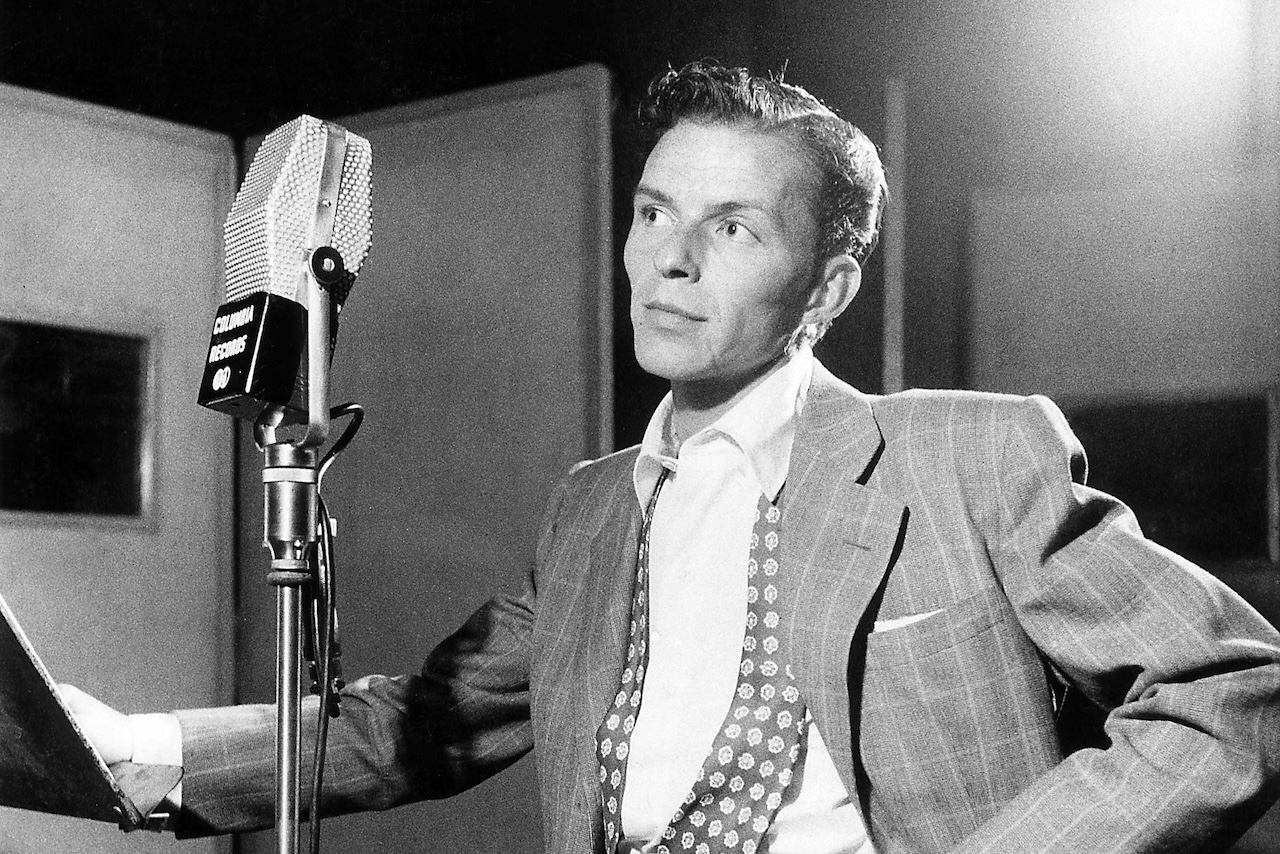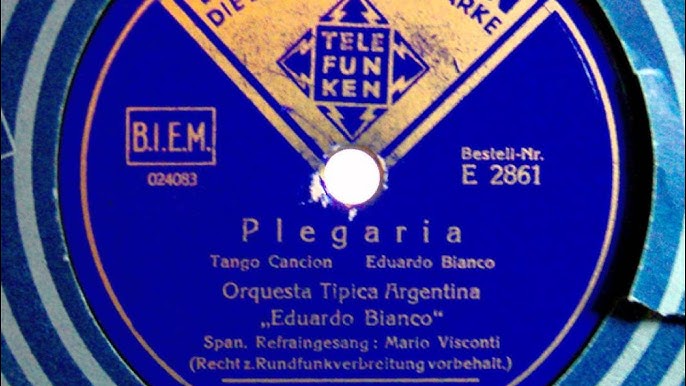
Plegaria wasn’t a “Todestango” (“tango of death”) after all.

During the Second World War music played a huge role in people’s lives. Songs such as We’ll meet again articulated the hopes of entire peoples, whilst Sentimental journey became an anthem amongst service personnel longing for the end of hostilities. But music was also to be found in the darkest places. Many concentration camps had camp orchestras which were forced to play at various moments, including during executions.

After the war, the Polish poet, journalist and singer Aleksander Kulisiewicz (who was interned in Sachsenhausen) spent decades collected poems, music and songs from the camps. In 1979 some of these were recorded by Smithsonian Folkways and released on an album entitled Tangos From the Depths of Hell. Amongst them was a poem from the Janowska Concentration Camp near Lviv (at that time part of occupied Poland and known as Lemberg) that had been set to the music of Eduardo’s Bianco mournful tango Plegaria. This poem references a Todestango, and it was assumed that this was the Todestango or “Death Tango” which was played by the camp orchestra during executions. This claim has been widely spread – you can read it, for instance, in Julio Nudler’s excellent book “Tango judió – Del ghetto a la milonga”, and it is stated as a fact on the website of the Holocaust Museum. You can also read it in the first printing of my book on Osvaldo Fresedo. (Note that this is a specific claim about one camp, the Janowska camp: other camps might also have had a Todestango, but these would have been different ones. Todestango is thus a genre rather than a specific piece of music).

During his long stay in Europe, Bianco courted the rich and powerful, playing before dictators such as Hitler, Mussolini and Stalin. He is thought to have been a fascist sympathiser and it was thus easy to attribute a Todestango to him. But is it true? Recent research indicates that it was not. According to William de Haan, a Professor of Criminology at Vrije Universiteit Amsterdam – and a tango dancer – it was far more likely to have been Ta ostatnia niedziela (The last Sunday), a very popular and well-known tango in pre-war Poland. The composer of Ta ostatnia niedziela, Jerzy Petersburski, was popular in the Soviet Union (whose army liberated the Janowska camp). For Bianco to have been the author of a “Tango of Death” was a more convenient story for the Soviets. It also made for a much more compelling story, and the tale grew in the telling.

This is the briefest possible summary of a very complex topic. If you want to know more, I refer you to two recent books below.

I’ll leave you with my favourite version of Plegaria, the original and best in my opinion, recorded by the Bianco-Bachicha orchestra in Paris in 1927.

References
[1] Willem de Haan, Tango of Death: The Creation of a Holocaust Legend, 2023. ISBN: 978-90-04-52506-1. Read the beginning of Chapter 3 of de Haan’s book on the publisher’s website.
[2] Dirk Dietz, »Der Todestango«: Ursprung und Entstehung einer Legende, transcript, 2022, 206pp. ISBN: 978-3837662047

Pitch and tempo accuracy in early jazz recordings

The issue of the correct pitch of tango recordings first came to our awareness when we noticed that LP transfers of old shellacs had been sped-up, raising both the pitch and the tempo. Later we discovered that the pitch of the original recordings was itself suspect because of technology issues. Surprise surprise, the same technology issues also affected jazz recordings.

The most celebrated case is that of Louis Armstrong’s early recordings with his Hot Five and Hot Seven on the Okeh label in 1925-1927. People noticed that Cornet Chop Suey appeared to be in the key of E, which was a very strange choice for a trumpet. Thinking that the transfer must have been sped up, the jazz community first thought that the correct key was E flat – an easy key for a trumpet. This reduced the tempo, leading to the feeling that the Hot Five had played at a relaxed, laid-back tempo. Similarly, Big Butter and Egg Man played back in the key of F#. Surely, the correct key was F.

However we now know that all the early recordings on the Okeh label were made at a speed closer to 80bpm, which meant the transfers made at 78rpm were not too fast, but too slow. Cornet Chop Suey and all the recordings made on Okeh in 1925-1926 – so all the recordings of the Hot Five – actually needed to be sped up. Early reissues were at the wrong pitch, although Sony have now fixed this.

Just as with tango, incorrect pitch was found not to be just a technical question. Because of the impact on tempo, it affects the feeling of the music as well – just as it does with tango (see my primer on this topic). And that’s why it matters.

The untypical French típica of Brodman-Alfaro

Of all the bands playing tango in Paris in the 1920s, the most intriguing is that of Brodman-Alfaro. Formed in June 1928, the orchestra was co-led by two local men, Pablo Brodman (violin) and Jean-Max Levesque, a classically trained musician who, after hearing the Argentine pianists Luis Cosenza and Enrique Delfino playing tango in a restaurant in Montmartre, switched from cello to piano in order to perform tango, changing his name to the more Spanish sounding Jean Alfaro.

The formation of the group had to wait until they could find a pair of good bandoneon players, a commodity always in short supply in France. The men they found were the Colombo brothers, Joseph (Guiseppe) and Hector (Ettore), born in Piedmont. The brothers had learnt the accordion as children and switched to bandoneon in Paris, where they played for a while with the Bianco-Bachicha orchestra (perhaps until it departed for Spain in early 1928). They are really skilled players, able to play the bandoneon variations that Pedro Laurenz is performing in Julio De Caro’s recordings (such as the one on Mala junta).

The band experienced immediate success and in many ways was the most advanced of its day. On the one hand, they respected both the clear beats of Canaro (who had been all the range in Paris in 1925-1926), but they also liked Fresedo (who arrived in Paris at the end of 1928) and in particular the harmonized melodies of the De Caro brothers (who came to Europe only in 1931). In an interview given in 1930, whilst admiring Fresedo’s lighter and livelier beat, the men noted that he had not been as successful in Paris as had been expected, commenting “We believe that it interested musicians more than dance lovers”. Of Julio De Caro (whom they had not yet heard in person at the time of the interview) they wrote: “De Caro had the merit of having escaped from the primary formulas of tango; he understood that, without altering its character, it could be enriched with beautiful harmonies. He knew how to surround himself with brilliant instrumentalists; his orchestration is original and varied”. [1]

The band recorded on Pathé, Columbia (in early 1929 and again in 1932) and on Disque “Gramophone”. There is no published discography.

The repertoire of the band displays these preferences, with danceable versions of Francisco De Caro’s Flores negras and Cobián’s Pico de oro. Some of their versions lack power, but there is a very interesting comment in their interview about the difficulties of recording the rhythmic melody as played with the heel of the violin bow: “These effects, very common in dance halls, are rarely heard on records; they must be avoided, their use being too brutal for the sensitivity of the microphone. However, a good tango violinist must know how to do them brilliantly. It is a somewhat special technique that no school teaches; so a certain amount of training is required to be able to make them biting, strong, in time and… without breaking too many strings”. The implication is that they played differently for dancers than they did on the records.

I leave you with one of my favourite interpretations by the band, Agustín Bardi’s Lorenzo, recorded on 25th June 1929:

References

[1] Tango Sasha: Brodman-Alfaro, 24-01-2018
[2] Jean Alfaro on Bibletango

Tristesse

Many people have noted the connection between the tango La melodia del corazón, well known in the 1940 recording of Edgardo Donato, and Chopin’s piano étude Op. 10, No. 3.
When the same thing happened to me, many years ago, I asked my dad (who never danced tango) about it because I could remember him humming this tune when I was a small child. He told me that the lyrics began “How deep is the night”, and so I knew immediately that the connection between Chopin’s melody and popular music was not confined to tango. But which came first – the tango version, or another?
The most well known version in English, bizarrely, is one by the comedian Ken Dodd. The melody is said to have been used in the 1938 Bette Davis Movie “Jezebel”, and there is also a version with German lyrics recorded the same year by the Viennese Singing Sisters for the film “Memories of Chopin”

Jens-Ingo traced the tango versions to a 1939 arrangement made in Paris by Mario Melfi with the title “Reviens mon amour”, which was a big hit for Bruno Clair, but take a look at the sheet music: as a sub-title, it gives another name – Tristesse – Sadness. That’s also the title used by Tino Rossi, singing in French, in his 1939 recording:

Chopin considered this his most beautiful melody. He published it in Paris in 1833, having left Warsaw for Vienna in 1830. Less than a month later, his native Poland was thrown into war by the November uprising, an armed rebellion against the Russian Empire which ruled part of the nation (which was partitioned between Russia, Prussia and Austria, and did not exist as a separate country). It is easy to hear in the melody Chopin’s heartbreak at the fate of his country; one of his pupils reported that during a class, while he was demonstrating this piece, Chopin broke down in tears crying, “Oh my homeland!”

Sivul Wilenski – tango’s photographer

The majority of the pictures of the great tango musicians of the past were taken by just a handful of photographers. Today I want to introduce you to the most prolific: Sivul Wilenski, who is now forgotten by all save for a small group of enthusiasts. Born in Poland in 1897, Wilenski came to Buenos Aires in 1920 as a member of Iván Totsoff’s theatre company. Here he became interested in photography and started getting work after some years at the newspaper La Razón, taking photographs of society beauties for the “Notas Societas” pages. When La Razón opened an office in Paris he was sent there to open an exhibition of his photographs, staying for three years whilst he apprenticed himself to Parisian studios, developing himself as a photographer. His son Osias says that Sivul was much influenced by French poetic cinema – think of the films of Jean Renoir such as La Grande Illusion (1937) and The Rules of the Game (1939).

Wilenski returned to Buenos Aires in 1930, opening his first studio at Florida 118, but then returned to Paris in 1931 to photograph the massive Exposition Coloniale Internationale. In 1932 Wilenski moved his studio to Santa Fé 997. He now took photographs of people from the world of entertainment and culture: not just tango, but also theatre, cinema and dance. Many of his pictures were published by the magazine Sintonía. Wilenski nearly always retouched his photographs before printing (no photoshop in those days!) and when he did so he signed them. The rounded initial ‘W’ is very characteristic, making it easy to identify his work in the majority of cases.

After Wilenski died in 1952 his family donated his negatives to the Museo del Cine in the barrio of La Boca. In 2023 the museum arranged an exhibition of his work which again passed largely unnoticed by the tango community. The pictures are not as dramatic as those of Annemarie Heinrich, who started out as his pupil, but show people in natural poses. I hope this little article will raise appreciation for his work – look out for his signature on the photos on sheet music covers.

References:
Facio, Sara: La fotografía en la Argentina Desde 1840 hasta nuestros días. Buenos Aires, La Azotea Editorial Fotográfica, 1995.

Tango and Coffee: Is ‘El tigre Millán’ this year’s ‘Tormenta’ ?

Francisco Canaro: some love him, some hate him, but if you know me then you’ll know that my position is more nuanced. I adore his work with Charlo, and his valses, especially the early ones; and I also have a great affection for his work with Roberto Maida in the late 1930s. But when Maida quits at the end of 1938, the quality of Canaro’s work falls off a cliff. Nothing demonstrates this better than Canaro’s interpretation of Tormenta, Discépolo’s cry of existential dread. Canaro reduces the dark night of the soul to a soap opera in a performance that I can only describe as relentlessly superficial. I’ve long considered it the worst tango, ever; listening to it, for me, is a torment.

Tormenta (image generated by Bing AI)

Despite these obvious shortcomings, Canaro’s Tormenta has been a popular tango over the years: Canaro’s insistent, almost martial rhythm can get the dancers going. I remember complaining about Tormenta to a tango colleague twenty years ago. He commented: It’s like a cup of coffee… paused, and added: a bad cup of coffee. I have to say, he was bang on. Canaro’s Tormenta is a cup of bad instant coffee. It’s that big old jar of Nescafé that stares you in the face every time you open the kitchen cupboard, years after you’ve switched to something better. But for those moments in which you need a coffee so badly that even a bad one will do, it does the job.

Two decades later the scene seems to have tired of Tormenta; maybe we’ve finally finished that twenty year old maxi-jar of Nescafé. But the idea of a “go-to” tango that can make the dead dance has not gone away.

The mantle has been resting on D’Arienzo’s shoulders for a little while now – don’t forget that his music was once described as capable of waking the dead. In Argentina they used to play D’Arienzo’s La Bruja in this moment, but that’s not fast enough for us – especially once we started playing it at the proper (slower) speed. For a few years it was Mandria that we heard several times at almost every weekend event. Mandria is also like coffee, but it’s a good Italian coffee, a nice double espresso. Some of you may have noticed a not insignificant coincidence: both these interpretations were recorded in 1939, tango’s most intense year. Argentina was partying hard whilst in Europe the fuse ran down on the powder keg of war and then exploded.

So it was interesting for me to hear one D’Arienzo tango played three times in a weekend recently: El tigre Millán. Recorded one year after Mandria, this is not as hard and intense but it is even faster: 68 bpm compared to 67 bpm. That’s fast. D’Arienzo’s 1940 band is more sophisticated than his 1939 one, so this is a bit of a change in the community’s taste.

What next? Di Sarli’s Catamarca has been tried, but it’s just a bit too complex. Troilo perhaps? Sadly we have no recordings from 1939 and 1940. Milongueando en el 40 and the other classic 1941 sides don’t have the same intensity. They are more like a good cappucino: stimulating, yes, but meant to be savoured, rather than thrown back in a single gulp before the milonga. Perhaps some Biagi? Son cosas del bandoneón is well known but has never achieved the gold status of Tormenta, Mandria or El tigre Millán, whilst Pura clase is just too joyful. Gólgota? Too slow… reader I don’t know!

Tango By Year


When the pandemic struck, my friend and colleague Dag Stenvoll (Bergen, NO) had an idea: how about doing a free online Zoom show for the tango community? To slice the cake differently, his idea was to choose a particular year. He would choose the year and the tracks to play, and I would talk about them. The twist: I wouldn’t know which numbers he was going to play – only the year. I agreed, and Tango By Year was born. Over the next 18 months we did 38 shows – over 130 hours of programming, covering 1927-1955 – the core years of tango – with a few bonus programmes. All the episodes are freely available for listening on the TBY Soundcloud (optional donation).

1st March 1926: Electrical recording arrives in Argentina

Victor 79632-A - Rosita Quiroga - La Musa Mistonga

It’s an electrical recording – but can you tell?

In March 1926 the Victor company were the first to bring electrical recording to Argentina. Although their rivals Odeon were not able to follow suit until November this did not give Victor a competitive advantage: both parties had an interest in not advertising the new technology because – if it was really so much better than acoustic recording – who would buy the stocks of old acoustic discs? Victor and Odeon came to a gentleman’s agreement, and no announcements were made. Accordingly, Victor made no changes to their numbering system, continuing with the same matrix numbers, and there was no way of telling if the disc had been recorded acoustically or electrically. Once Odeon went electric in November, Victor’s discs would bear the monogram VE: Victor Electrical.

The first electrical recording was matrix BAVE (Buenos Aires Victor Electrical) 753 and this was given to Rosita Quiroga. It sold over 14,000 copies. By way of contrast, Agustín Magaldi would sell between 5,000 and 16,000 copies, Carabelli’s Jazz Band 7000 copies, and De Caro 1,500. Quiroga’s third disc, Mocosita c/w Horas tristes, sold 26,000 copies.

date matrix artist title genre disc
1st March BAVE 753-2 Rosita Quiroga La musa mistonga tango 79632-B
1st March BAVE 754-2 Rosita Quiroga Beba tango 79632-A
BAVE 755-1 Ramón Franco Todo por la raza monólogo 79633
BAVE 756-1 Salutación del Mayor Zanni al Comandante Franco monólogo 79633
BAVE 757-2 Carabelli Jazz Band Ingenuamente fox trot 79634-A
BAVE 758-1 Carabelli Jazz Band Gitana de ojos moros paso doble 79635-A
BAVE 759-2 Carabelli Jazz Band Comandante Franco paso doble 79634-B
7th April BAVE 760-1 Rosita Quiroga Como luces de bengala tango 79638-B
7th April BAVE 761-1 Rosita Quiroga Son grupos tango 79638-A
BAVE 762-2 Rosita Quiroga / Juan Velich El amor a golpes escena cómica 79639-A
BAVE 763-2 Compañía Victor de Comedias Pum… Garibaldi escena cómica 79639-B
8th April BAVE 764-2 Rosita Quiroga Mocosita tango 79641-A
8th April BAVE 765-2 Rosita Quiroga Horas tristes tango 79641-B
BAVE 766-3 Carabelli Jazz Band Voronoff fox trot 79635-B
BAVE 767-1 Trío Los Nativos El crucifijo tango 79640-B
BAVE 768-1 Trío Los Nativos La china Hilaria ranchera 79640-A
12th April BAVE 769-2 Julio De Caro Mary tango 79636-A
12th April BAVE 769-2 Julio De Caro Feliz viaje tango 79636-B
12th April BAVE 771-2 Julio De Caro Mis desvelos Tango 79637-A
12th April BAVE 772-1 Julio De Caro Quince abriles vals 79637-B
14th April BAVE 773-1 Agustín Magaldi ¿Dónde estás? shimmy 79642-B
14th April BAVE 774-2 Agustín Magaldi Hilos de plata tango 79643-A
BAVE 775-2 dúo Magaldi-Noda Lirio azul vals 79642-A
BAVE 776-1 dúo Magaldi-Noda Sauces del Chorrillo tango 79643-B

And who is this Comandante Franco guy? If you think he sounds like a military type, you would be right: this is General Franco’s younger brother Ramón Franco. He made history in January 1926 by flying a Dornier flying-boat named Plus Ultra (!) from Spain to Buenos Aires, a distance of just over 10,000km. The flying time was nearly 60 hours.

Juan Maglio – “La guardia vieja” (1927-1932)

If you’re not sure about Maglio then try this album, compiled by Carlos Puente and released by Euro Records in their “Colección 78RPM” (EU-17052), and now present on all the digital platforms. Vardaro plays on all the 1927 tracks (tracks 1 to 5), but that’s not to say that those are the best tracks on this compilation – not at all!
A prototypical figure of the old guard (guardia vieja), Maglio made changes to his band to respond to the changes being wrought by the new guard of De Caro et al. In 1929 he assembled a new bandoneon lineup with Federico Scorticatti, Gabriel Clausi and Ernesto Di Cicco (Minotto’s brother) – all top players, and in En un rincón del café they unleash a variación which is simply stunning.
From November 1929 Vardaro was occupied by the Vardaro-Pugliese sextet but he is present on some of the 1930-1931 recordings such as the creamy Abrojos – and just listen to his tone in the long intro to the vals Princesa. From 1932 onwards he is again present in all the recordings, with a superb solo in Mi queja.
Finally, for the most complete arrangement of the album listen to Alma triste. As well as Vardaro’s beautiful violin we get a final variación on the bandoneons which is clearly in multiple voices (the different men play different notes). This is the era of which Troilo commented that Maglio could not understand the music that his own band was making – not only did he no longer play in these lineups, he sometimes didn’t even attend.
Thanks to Osvaldo Vardaro for confirming in which years Elvino Vardaro is present in the band.

Roberto Firpo (1927-1929)

A delicious album of late 1920s Firpo from RGS with an astonishing resemblance to CTA-741. Reasonable transfers of fairly clean discs make this easy to enjoy. Teófilo Ibáñez is the vocalist on four tracks including an unusual vocal version of Marejada (a track more familiar to us from the 1941 version of Carlos Di Sarli) although Organito del suburbio is more satisfying.
Firpo’s special qualities – his romantic sense of melody, the deep wailing melancholy of the violins – come to the fore in the instrumentals, with 9 de julio | Nueve de julio, A la luz del candil, Cotorrita de la suerte, La cumparsita, Entre tangos y champagne and Oí malevo all being stand-out tracks. That’s a lot of stand-out tracks – an excellent album, especially if you’re not familiar with the artist in this period.
Geek note: The title of Entre tangos y champagne is given incorrectly, with “tango” in the singular.
Published on both Spotify and Youtube:

Youtube: